Staying composed, adaptive, and dangerous under pressure.
How to Be Mentally Strong and Actually Overcome Shit
Mental strength is not about being calm, positive, or unbothered. It is about what happens when things go wrong, because they will. Pressure, failure, rejection, bad days, missed shots, and dumb mistakes are guaranteed.
What separates people who keep winning from people who stall is not talent or motivation. It is whether they have a system for taking hits without imploding, dragging it out, or turning it into a personality crisis.
This is that system.
The Four Parts of Overcoming Challenges
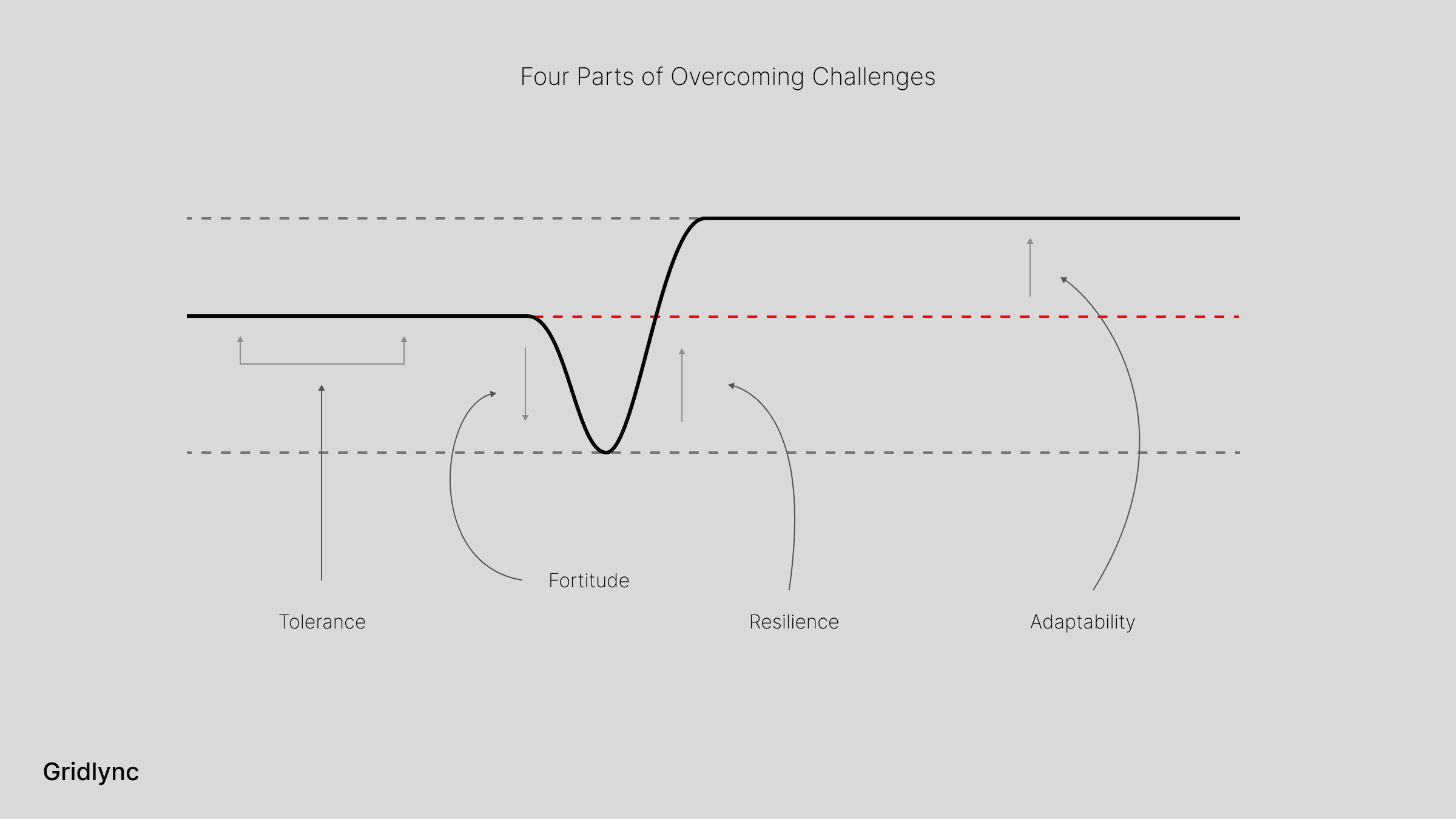
Overcoming challenges is not one vague trait. It is four separate things that happen at different moments when shit goes sideways.
1. Tolerance
How long you can take pressure before it actually affects your mental or physical state (how long until you lose your shit).
Tolerance is time to impact.
Short fuse equals low tolerance
Long fuse equals high tolerance
Tolerance is not feeling nothing. Being affected is not binary. Pressure builds in layers. High tolerance means you stop that pressure from blowing up into bad decisions, spirals, or identity-level damage.
Bad things happen. I do not eliminate them. I contain them.
2. Fortitude
How bad your behavior gets once you are already affected (how much of your mind you actually lose).
Fortitude is damage control.
Examples:
Quitting, blowing up relationships, self-destructing, doing dumb impulsive shit equals low fortitude
Pausing, slowing down, taking a walk, not making it worse equals high fortitude
Fortitude is not about staying perfectly composed. Some reaction is unavoidable. The question is how destructive that reaction becomes.
3. Resilience
How long it takes you to get back to normal after things already went south (how long until you are functional again).
Resilience is recovery speed.
Examples:
Back to baseline in minutes, hours, or days equals high resilience
Stuck for weeks, months, or forever equals low resilience
Resilience does not care how hard the hit was. It only cares how long the hit controls you.
4. Adaptability
What your new baseline looks like compared to your old one after recovery (did this make you better or fuck you up).
Adaptability is long term direction.
Examples:
You come back stronger than before equals high adaptability
You come back the same equals medium adaptability
You come back worse equals low adaptability
Returning to baseline is resilience. Exceeding baseline is adaptability.
Where Most People Get Stuck
Most people have low tolerance and low adaptability. That means they get triggered easily and learn nothing after things go wrong. Same problems, same reactions, same outcomes, over and over.
That loop never fixes itself.
Which Techniques to Use and When
These four dimensions are not meant to be used simultaneously. Each applies at a different point depending on your state. Using the wrong technique in the wrong state creates more damage instead of less.
When you are still mostly stable, tolerance is the correct tool. This is the state where you feel irritated, tired, annoyed, low energy, or generally stressed, but nothing has fully blown up yet. In this phase the goal is containment. You do not analyze yourself, you do not interpret meaning, and you do not plan the future. You limit the blast radius and let the pressure dissipate. Tolerance is used before behavior meaningfully changes.
Once your state has clearly shifted, fortitude becomes the priority. This is the moment of emotional spikes, urges to react, impulses to quit or escape, loss of control, agitation, or shutdown. The objective here is damage control, not resolution. You slow everything down and avoid irreversible actions. You do not try to fix the situation or explain what it means. Fortitude is used after impact, when control matters more than clarity.
After the immediate reaction has settled but you are still not back to baseline, resilience takes over. This phase often feels foggy, flat, or drained. You are no longer spiraling, but you are not fully functional yet. The focus is on recovery speed and re-entering structure. You resume normal behavior in small increments without waiting to feel motivated or inspired. Resilience is used during recovery, not during chaos.
Once you have returned to a stable and functional baseline, adaptability finally applies. At this point you are regulated and thinking clearly again. Now you extract lessons, upgrade systems, and make permanent improvements. You do not adapt emotionally or rewrite identity. Adaptability is only valid after recovery is complete. It is how the baseline is raised over time, not how disruption is survived.
The Ideal Operating State
The ideal setup looks like this:
High tolerance so it takes a lot to shift your state
High fortitude so even if your state shifts, your behavior stays under control
High resilience so if you do get knocked off baseline, you recover fast
High adaptability so after recovery your baseline is higher than before
That is how forward progress compounds.
How to Build High Tolerance
Tolerance is not about avoiding pain. Being affected is not on or off. Pressure comes in waves. Tolerance is stopping those waves from turning into a full blown meltdown, bad decisions, or identity damage.
Tolerance for Small Shit (day to day nonsense)
Treat small negatives like weather.
Bad days equal weather
Weather does not need interpretation
Do not ask why
Do not attach meaning
Contain the blast radius.
Small negatives are allowed to affect:
The next 30 to 90 minutes
They are not allowed to affect:
The entire day
Your identity
Tomorrow
This week
Take one stabilizing action and then stop.
Drink water
Eat something
Step outside
Clean one surface
Do not try to fix bad days. Absorb them and move on.
Tolerance for Big Shit (major hits)
Immediately after impact:
No conclusions for 24 to 72 hours
No identity judgments
No future predictions
Narrow the damage.
What actually changed
What did not change
Convert pain into structure.
What system change prevents this exact failure again
Protect identity continuity.
One event does not rewrite who you are
How to Build High Fortitude
Once something affects your state, some reaction will happen. Fortitude is how much control you keep once that happens.
Recognize fortitude moments:
Emotional spike
Loss of focus
Urge to react
Desire to quit or escape
Physical agitation or shutdown
The goal is not calm. The goal is not making it worse.
Pause all high impact decisions.
No quitting
No ending relationships
No big financial or strategic moves
No emotionally charged messages
Delay is control.
Shrink the action surface.
Do less, not more
Choose reversible, low risk actions
Examples:
Step away instead of confronting
Write notes instead of sending messages
Slow work instead of aggressive work
Stop for the day if needed
Regulate before responding.
Walk
Breathe
Hydrate
Stretch
Change environments
Channel energy instead of suppressing it.
Physical movement
Low stakes tasks
Grounding routines
Maintain minimum standards.
Food
Water
Sleep
Hygiene
Respectful communication
End the episode without narrative.
Do not ask what this says about you.
End with this:
“I handled this without making it worse.” That counts as a win.
How to Build High Resilience
Resilience is not toughness in the moment. It is how fast you get your shit back together after disruption.
Mark the disruption as temporary.
“This is a disruption, not a new normal”
Define baseline clearly.
Baseline means functional and regulated, not motivated or inspired.
Recover one dimension at a time.
Recovery is not linear.
Valid paths:
Physical to mental to emotional
Functional to emotional to motivational
Behavioral to cognitive to physiological
Any axis restored counts.
Lower friction to normal behavior.
Smaller work blocks
Easier tasks
Partial routine re entry
You do not snap back. You slide back in.
Do not wait to feel ready.
Action creates readiness, not the other way around.
Avoid secondary damage.
Do not isolate, catastrophize, or abandon structure.
Mark recovery explicitly.
“I am back to baseline”
Unmarked recovery turns into stagnation.
How to Build High Adaptability
Adaptability is measured only after recovery is complete. It determines whether the negative event permanently improved you, did nothing, or fucked you up.
Levels of Adaptability
High adaptability means your new baseline is higher
Medium adaptability means you returned to the same baseline
Low adaptability means your baseline dropped
Returning to baseline is resilience. Exceeding baseline is adaptability.
Steps to High Adaptability
Do not adapt while disrupted.
No permanent conclusions until baseline is restored
Identify the exact failure vector.
System
Assumption
Behavior
Environment
Never target identity. Always target mechanics.
Extract one permanent upgrade.
Add a system
Change defaults
Remove a dependency
Introduce constraints
Automate a failure point
One upgrade is enough.
Encode the upgrade into reality.
Written rules
Checklists
Calendar constraints
Environment changes
Automation
If nothing in the real world changed, adaptability did not happen.
Defend the new baseline.
Resist regression
Enforce the new rule under pressure
Mark the upgrade.
“This event permanently raised my baseline”
Marked gains stick. Unmarked gains fade.
Conclusion
Tolerance buys time.
Fortitude limits damage.
Resilience restores baseline.
Adaptability raises it.
This is unshakeable execution.